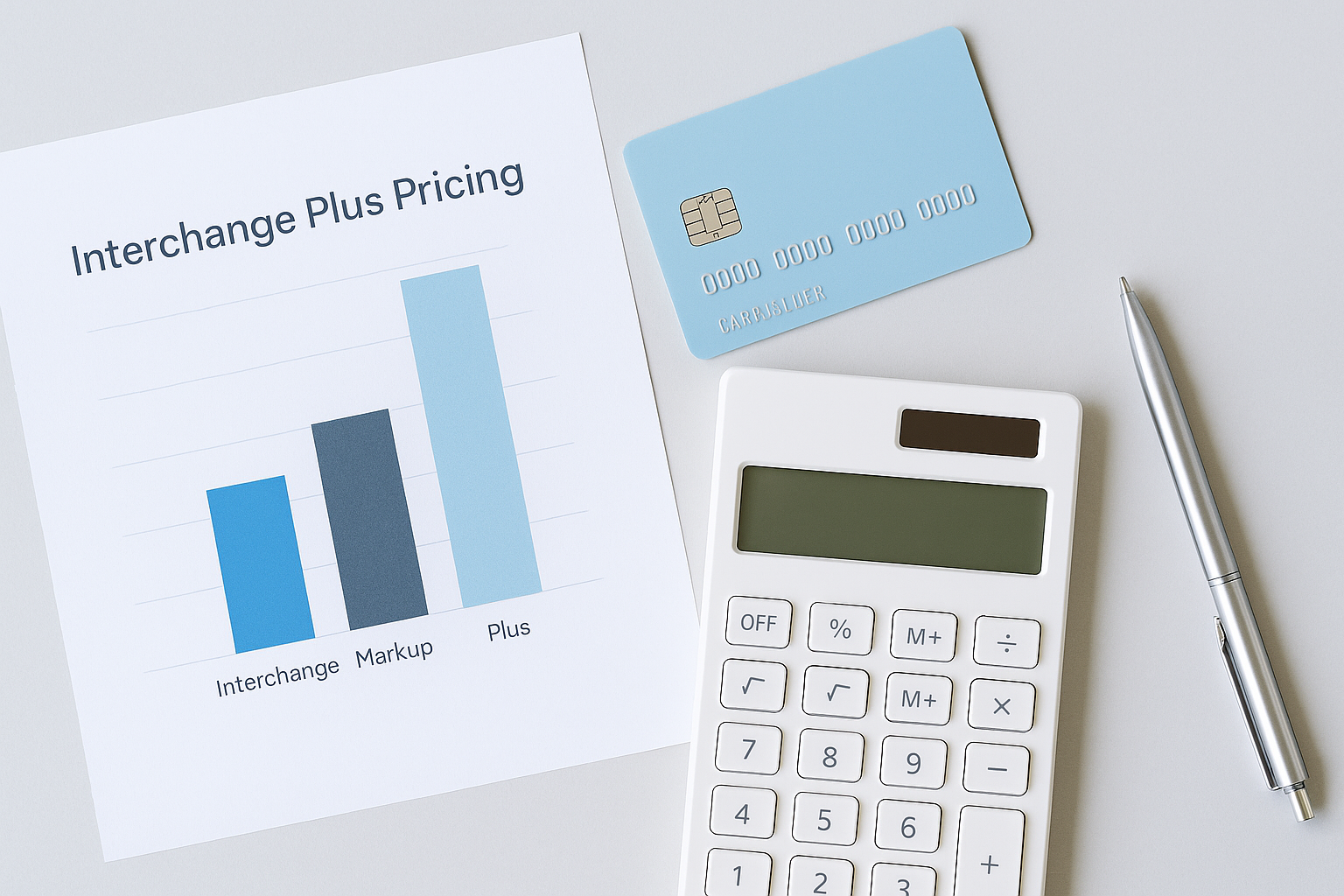
What Is Interchange Plus Pricing?
Interchange plus pricing, often called interchange++, is a payment processing model that breaks card processing costs into two parts: the card network’s interchange fee and the processor’s markup. Instead of combining everything into one blended rate, the processor passes through the actual interchange cost and adds a transparent fee for its services.
This model is widely used by merchants that want clearer pricing and better visibility into what they are paying for each transaction. Because the interchange portion is set by card networks and issuing banks, it varies based on factors like card type, transaction method, and merchant category. The processor’s markup is the part you negotiate.
In simple terms, interchange plus pricing means you pay the real cost of accepting a card, plus a known service fee. For many businesses, that transparency is the biggest advantage.
How Interchange Plus Works
Every card transaction involves several parties: the customer’s bank, the card network, the processor, and your business. When a payment is approved, the issuing bank charges an interchange fee to compensate for taking on fraud and credit risk. The card network may also assess assessment fees. Your payment processor then adds its own markup for handling the transaction and providing support, software, and account services.
Under interchange plus pricing, your statement typically shows these components separately. For example, a transaction might include the interchange cost, a small card brand fee, and the processor’s per-transaction or percentage-based markup. Because each part is visible, you can see exactly where your money is going.
This structure differs from flat-rate pricing, where all costs are bundled into one rate, such as 2.9% + 30¢. It also differs from tiered pricing, which groups transactions into categories that can make costs harder to predict.
Example of a Transaction
Imagine a $100 credit card sale. The interchange fee may be 1.80% + 10¢, the card network fee may be 0.13%, and the processor may charge 0.30% + 10¢. Your total processing cost would be the sum of those pieces. If the transaction meets a lower interchange qualification, your cost could be lower; if it is considered higher risk, the cost could be higher.
This variability is important: interchange plus pricing is not one fixed rate. It reflects the actual mix of cards and transaction types your business processes.
Benefits of Interchange Plus Pricing
One of the biggest advantages of interchange plus pricing is transparency. Businesses can clearly see interchange costs, network fees, and processor markup instead of trying to decode a bundled rate. That visibility makes it easier to compare providers and understand monthly statements.
Another major benefit is fairness. Since interchange is passed through at cost, merchants are not overpaying to cover the processor’s risk on higher-cost cards when their transactions qualify for lower rates. Businesses with good card acceptance practices, especially those with debit card volume or in-person card-present transactions, may save money compared with flat-rate pricing.
Interchange plus also scales well. As a business grows, the detailed pricing structure makes it easier to identify opportunities to reduce costs, such as improving transaction quality, encouraging lower-cost payment methods, or optimizing eCommerce checkout flows.
In addition, this model often appeals to businesses that want negotiation power. Because the markup is separate, merchants can focus on reducing the processor’s margin without needing to change the pass-through interchange component.
Challenges and Drawbacks
Despite its advantages, interchange plus pricing is not always the simplest option. Monthly statements can be more complex than those of flat-rate plans, especially for owners who want a quick and easy way to predict costs. The number of fee lines may feel overwhelming at first.
It can also be harder to estimate the exact cost of each transaction before it settles because interchange fees depend on many variables. These include whether the card is debit or credit, whether the payment was swiped, inserted, tapped, or keyed in, and whether the transaction is domestic or international.
Some providers also add extra fees beyond the basic markup, such as monthly account fees, PCI compliance fees, batch fees, gateway fees, or chargeback fees. If you are comparing offers, these additional charges matter just as much as the headline markup.
Finally, interchange plus pricing may not be ideal for very small businesses with low monthly volume or businesses that prioritize simplicity over optimization. In those cases, a flat-rate plan may be easier to manage, even if it costs a bit more.
Who Should Use Interchange Plus Pricing?
Interchange plus pricing is often best for businesses with moderate to high processing volume. The more transactions you run, the more valuable transparency and small savings can become over time. Retailers, restaurants, professional services, and growing eCommerce businesses frequently benefit from this model.
It is also a strong fit for businesses that process a wide range of card types. If you accept debit cards, rewards cards, corporate cards, and online payments, a blended rate may hide the real cost differences among those transaction types. Interchange plus makes those differences visible.
Businesses that want to negotiate and benchmark providers can also benefit. Since the markup is separate, it is easier to compare offers apples-to-apples and see whether one processor is charging a fair rate.
On the other hand, if you process only a small number of monthly transactions and prefer predictable billing, a simpler pricing model may be sufficient. The best choice depends on your volume, average ticket size, transaction mix, and tolerance for complexity.
How to Compare Interchange Plus Offers
When reviewing interchange plus pricing, do not focus only on the markup. The best offer is not always the one with the lowest advertised percentage. Instead, look at the full picture: interchange pass-through, card brand fees, monthly fees, minimums, chargeback costs, and any gateway or PCI-related charges.
Ask for a complete fee schedule in writing. A trustworthy provider should be able to explain its markup structure clearly and identify which fees are fixed, which are variable, and which are optional. If a processor uses vague language or refuses to provide a full breakdown, that is a red flag.
It is also smart to compare your expected effective rate. This is your total processing fees divided by your total card sales. A low markup does not always mean a low effective rate if other fees are high.
Finally, consider support, reporting tools, integration options, and contract terms. The right payment partner should offer more than just competitive pricing. Reliable service and clear reporting can save time and headaches later.
Tips for Lowering Your Payment Processing Costs
Even with interchange plus pricing, there are practical ways to reduce costs. First, encourage card-present payments when possible, since swiped, dipped, or tapped transactions often qualify for lower interchange than manually keyed entries.
Second, keep your account information and transaction data accurate. Missing details like address verification, tax amounts, or customer information can cause a transaction to qualify at a higher interchange level.
Third, review your statement regularly. Unexpected fees, downgraded transactions, or changes in your effective rate can be caught early if you monitor your account each month.
Fourth, negotiate your processor markup. While interchange is non-negotiable, the markup is not. If your sales volume has grown, you may be in a better position to ask for a lower rate or fewer ancillary fees.
Lastly, choose the right payment tools. A processor that supports smart terminals, secure online gateways, and fraud prevention features can help you qualify for better rates while reducing chargebacks and other costly issues.
Conclusion
Interchange plus pricing offers businesses a transparent and flexible way to pay for card processing. By separating actual network costs from the processor’s markup, it gives merchants better visibility and often better value than bundled pricing models. While the statements can be more detailed, the clarity is worth it for many businesses.
If you want a pricing structure that is easier to evaluate, easier to negotiate, and more aligned with your transaction mix, interchange plus pricing is worth serious consideration.