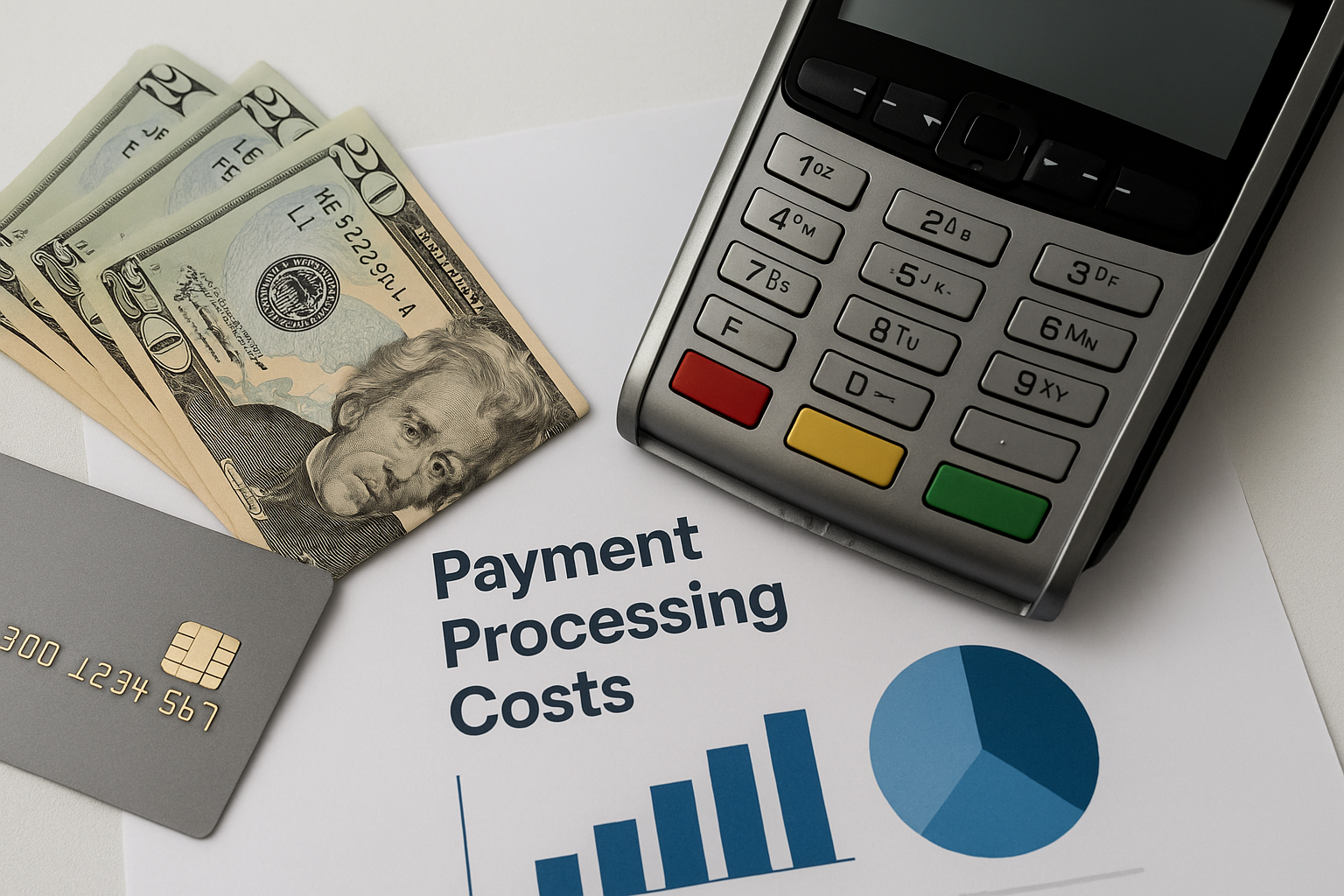
Understanding Payment Processing Costs
Payment processing costs are the fees businesses pay to accept credit cards, debit cards, and digital wallet payments. These costs may seem small on a per-transaction basis, but they can add up quickly as sales volume grows. For many businesses, especially those with tight margins, understanding these fees is essential for protecting profitability.
At a basic level, payment processing costs cover the systems and services that move money from the customer’s bank or card issuer to your business account. They typically include charges from card networks, banks, and the payment processor itself. The exact mix depends on the payment method, the processor you use, and the type of transaction.
Why these costs matter for businesses
Every percentage point matters when a business processes hundreds or thousands of transactions each month. A small increase in fees can reduce profit margins, raise operating costs, or force price changes. Understanding payment processing costs helps businesses choose better providers, set smarter pricing, and improve cash flow planning.
Common Types of Payment Processing Fees
Payment processing is not a single fee. It is usually a combination of several charges that appear in different ways depending on the provider. Knowing what each one means makes it easier to compare processors accurately.
Interchange fees
Interchange fees are charged by the card-issuing bank each time a card is used. These are usually the largest component of processing costs. The rate depends on factors like card type, transaction method, industry category, and whether the card was present at checkout.
Assessment fees
Assessment fees are charged by the card networks, such as Visa or Mastercard. These fees are generally smaller than interchange fees but still contribute to the total cost of accepting cards.
Processor markup
This is the fee the payment processor adds for its services. It may be a flat fee, a percentage, or both. Processor markup is often where businesses can negotiate savings, especially if transaction volume is high.
Monthly fees and account fees
Some processors charge monthly service fees, statement fees, PCI compliance fees, gateway fees, or account maintenance fees. These charges are not always tied to the number of transactions, so they can be especially important for businesses with lower sales volume.
Chargeback fees
When a customer disputes a charge and the transaction is reversed, the business may face a chargeback fee. Even if the dispute is later resolved in your favor, the fee may still apply. High chargeback rates can also lead to additional penalties or account reviews.
How Payment Processing Costs Are Calculated
Payment processing pricing is usually structured in one of several ways. The model a provider uses affects how easy it is to predict your total cost.
Flat-rate pricing
With flat-rate pricing, the processor charges the same rate for most transactions, such as 2.9% + $0.30. This model is simple and predictable, which makes it popular with small businesses. However, it may be more expensive than other models for businesses with larger transaction volumes.
Interchange-plus pricing
Interchange-plus pricing separates the actual card costs from the processor’s markup. This model is often more transparent and can be more cost-effective for many businesses. It is especially useful for companies that want to see exactly where their money is going.
Tiered pricing
Tiered pricing groups transactions into categories such as qualified, mid-qualified, and non-qualified. Each category has a different rate, but this model can be harder to understand and less predictable. Businesses may pay more if transactions fall into higher-cost categories.
Subscription or membership pricing
In this model, businesses pay a monthly fee for access to lower transaction rates. It can be a good fit for businesses with high processing volume, but it requires careful analysis to make sure the monthly cost is offset by transaction savings.
Factors That Influence Payment Processing Costs
Several business and transaction characteristics affect how much you pay. Two companies using the same processor can still have very different costs depending on how they accept payments.
Card type and payment method
Rewards cards, business cards, and premium cards usually carry higher interchange fees than standard consumer debit cards. Online and manually entered transactions are also often more expensive than in-person, card-present payments because they carry more risk.
Transaction size and volume
Small-ticket transactions can feel costly because fixed per-transaction fees take up a larger share of the sale. Businesses with higher volume may be able to negotiate better rates or choose pricing models that reduce total cost over time.
Industry and risk level
Some industries are considered higher risk due to chargeback frequency, fraud exposure, or regulatory concerns. High-risk businesses may face greater processing fees, stricter reserve requirements, or more limited provider options.
International payments
Cross-border transactions often cost more because they involve additional processing steps, currency conversion, and higher fraud risk. If your business serves global customers, these charges can have a significant impact on average processing cost.
How to Reduce Payment Processing Costs
While some fees are unavoidable, many businesses can lower their total processing expenses with a few smart strategies. The goal is not just to find the cheapest provider, but to choose the best fit for your transaction profile.
Compare pricing models carefully
Do not look only at headline rates. Review interchange, monthly charges, gateway fees, PCI fees, and chargeback costs before signing a contract. A lower percentage rate may still lead to higher total costs if the provider adds many extra fees.
Negotiate with providers
Processors may be willing to lower markups, waive certain fees, or offer custom pricing if your business has a strong transaction history or growing volume. It is often worth asking for a better rate, especially if you are evaluating multiple providers.
Encourage lower-cost payment methods
Where appropriate, encourage debit cards, ACH transfers, or other lower-fee payment methods. For B2B businesses and subscription models, bank transfers can sometimes be far less expensive than card payments.
Reduce fraud and chargebacks
Use address verification, card security tools, clear billing descriptors, and strong customer service processes to reduce disputes. Fewer chargebacks can mean lower direct fees and less risk of account penalties.
Improve transaction quality
Whenever possible, use card-present payments instead of manually keyed entries, and make sure your checkout process captures complete information. Lower-risk transactions often qualify for better rates and fewer issues.
Choosing the Right Payment Processor
The best processor is not always the one with the lowest advertised rate. The right choice depends on your business model, sales channels, transaction size, and growth plans.
Look for transparent pricing, responsive support, strong security features, and tools that fit your payment workflow. If you operate online, you may also need a processor with reliable gateways, fraud protection, and easy integrations with your e-commerce platform or accounting software.
It is also wise to review contract terms carefully. Watch for long-term commitments, early termination fees, minimum processing requirements, and hidden service charges. A provider that looks inexpensive at first may become costly over time if the terms are restrictive.
Conclusion
Payment processing costs are a normal part of doing business, but they should never be ignored. By understanding the different fee types, pricing models, and factors that affect total cost, you can make smarter decisions and keep more of each sale. A careful review of your current setup may reveal simple ways to reduce expenses and improve profitability.