What Is Flat Rate Credit Card Processing?
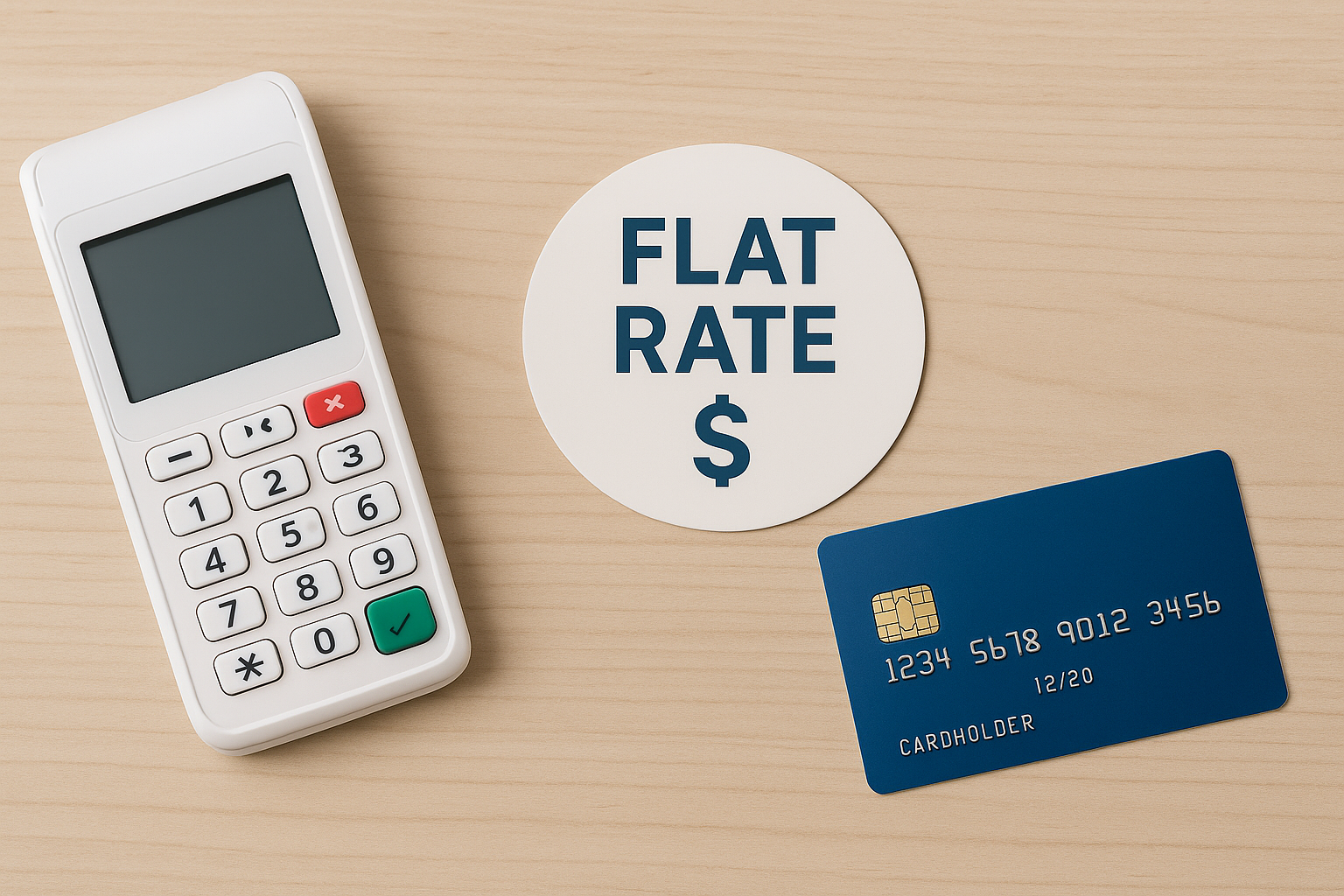
Flat rate credit card processing is a pricing model where a payment processor charges one fixed percentage, and sometimes a fixed per-transaction fee, for every card payment you accept. Instead of paying different interchange rates, assessment fees, and processor markups for each transaction, you pay the same rate across the board.
This makes the cost structure easy to understand. For many small businesses, that simplicity is the biggest appeal. You know what you will pay, your statements are easier to read, and you do not need to decode complicated pricing tiers.
How Flat Rate Pricing Works
With flat rate pricing, the processor bundles the many costs involved in card acceptance into one predictable fee. For example, a provider might charge 2.9% + $0.30 per transaction. Whether the customer uses a standard rewards card, a business card, or a premium credit card, the business pays the same advertised rate.
In contrast to interchange-plus pricing, you do not see separate pass-through network costs and processor markup line items. Everything is rolled into one rate, which is why this model is often marketed as “simple pricing” or “transparent pricing.”
Benefits of Flat Rate Credit Card Processing
Predictable monthly costs
One of the strongest benefits is predictability. If you process a fairly stable volume of transactions, flat rate pricing can make it easier to forecast your payment processing expenses. That can help with budgeting, pricing strategy, and cash flow planning.
Easy to understand
Many business owners do not want to spend time analyzing complex processing statements. Flat rate pricing removes a lot of that confusion. There is less guesswork, fewer hidden-fee worries, and less need to compare multiple fee categories.
Good for low-volume businesses
Flat rate processing can be a good fit for newer businesses, seasonal businesses, and companies with relatively low transaction volume. If you only process a modest number of cards each month, the convenience may outweigh the fact that the rate is sometimes higher than other pricing models.
Simple to quote and explain
If you need to communicate payment costs to a partner, accountant, or team member, flat rate processing is straightforward. There is usually no need to explain qualified, mid-qualified, and non-qualified rates or track every card type separately.
Potential Drawbacks to Consider
It can cost more on some transactions
The simplicity of flat rate pricing often comes with a tradeoff: it may be more expensive than interchange-plus pricing, especially for businesses that process a high volume of standard consumer cards. Since the processor includes all potential cost variations in one rate, low-cost transactions may end up subsidizing more expensive ones.
Higher fees for larger businesses
As your sales volume grows, the difference between pricing models can become significant. Businesses that process thousands of dollars per month, or much more, may save money with a pricing structure tied more closely to actual interchange costs.
Less insight into underlying costs
Flat rate pricing is easy to understand, but it does not show you what you are truly paying for card network costs versus processor markup. If you want full visibility into processing economics, this model can feel too bundled.
Flat Rate vs. Interchange-Plus Pricing
Interchange-plus pricing breaks your processing costs into two parts: the interchange fee charged by the card networks and the markup charged by the processor. This model is often viewed as more transparent and can be more cost-effective for businesses with higher volume or more favorable card mixes.
Flat rate pricing, on the other hand, trades some cost precision for simplicity. You pay the same rate on most or all transactions, which makes it easier to manage but not always the cheapest option.
Here is the simplest way to think about it:
- Flat rate: predictable and easy to understand
- Interchange-plus: more detailed and often more economical at scale
The right choice depends on how much you value simplicity versus potential savings.
Who Is Flat Rate Processing Best For?
Flat rate credit card processing tends to work best for businesses that want convenience over complexity. It is often a strong fit for:
- Small businesses and startups
- Retail stores with moderate card volume
- Service providers with simple transaction patterns
- Seasonal businesses that need predictable billing
- Businesses that accept payments online, in person, or both
If your business is still growing and you value a straightforward payment setup, flat rate processing can be a practical starting point. It can also be helpful if you do not have the time or expertise to monitor detailed processing statements every month.
How to Choose a Flat Rate Processor
Not all flat rate payment processors are the same. Before you choose one, look beyond the advertised rate and review the full pricing picture.
Check for hidden fees
Some providers advertise an appealing rate but add monthly fees, PCI compliance fees, chargeback fees, statement fees, or account closure fees. Make sure you know what is included and what costs extra.
Compare transaction types
Ask how the provider charges for in-person, online, keyed-in, and recurring payments. Some processors use different flat rates depending on how the card is entered or whether the transaction is card-present or card-not-present.
Review contract terms
Look carefully at contract length, cancellation terms, and equipment commitments. A slightly lower rate may not be worth it if you are locked into a long agreement or expensive hardware lease.
Consider integrations and support
Your payment processor should work smoothly with your point-of-sale system, ecommerce platform, or invoicing software. Reliable support matters too, especially if payment issues could interrupt sales.
Tips to Keep Processing Costs Lower
Even if you use flat rate pricing, there are still ways to reduce your overall processing expenses:
- Encourage card-present payments when appropriate, since they are often less risky than manually entered payments.
- Reduce chargebacks by using clear descriptions, good customer service, and accurate billing.
- Review your statements regularly so you can spot fees or patterns that may be costing you more than expected.
- Negotiate as you grow because many processors are willing to offer better terms as your volume increases.
- Compare providers periodically to make sure your pricing still fits your business size and transaction mix.
Conclusion
Flat rate credit card processing offers simplicity, predictability, and ease of use, which makes it appealing for many small and growing businesses. While it may not always be the lowest-cost option, it can be a smart choice if you value straightforward pricing and easy budgeting. The key is to compare providers carefully and make sure the convenience is worth the cost for your business.