Interchange Plus Pricing: A Clear Guide for Merchants
If you accept credit or debit cards, you’ve probably seen a lot of payment processing terms that sound similar but mean very different things. One of the most important is interchange plus pricing. It’s often considered one of the most transparent pricing models for merchant services, but it can also feel confusing at first glance.
In simple terms, interchange plus pricing separates the true cost of a card transaction from the processor’s markup. That structure makes it easier to understand what you’re paying for, compare providers, and spot unnecessary fees. Below, we’ll break down how interchange plus pricing works, why many businesses prefer it, how it compares with other models, and what to watch for before signing a contract.
What Is Interchange Plus Pricing?
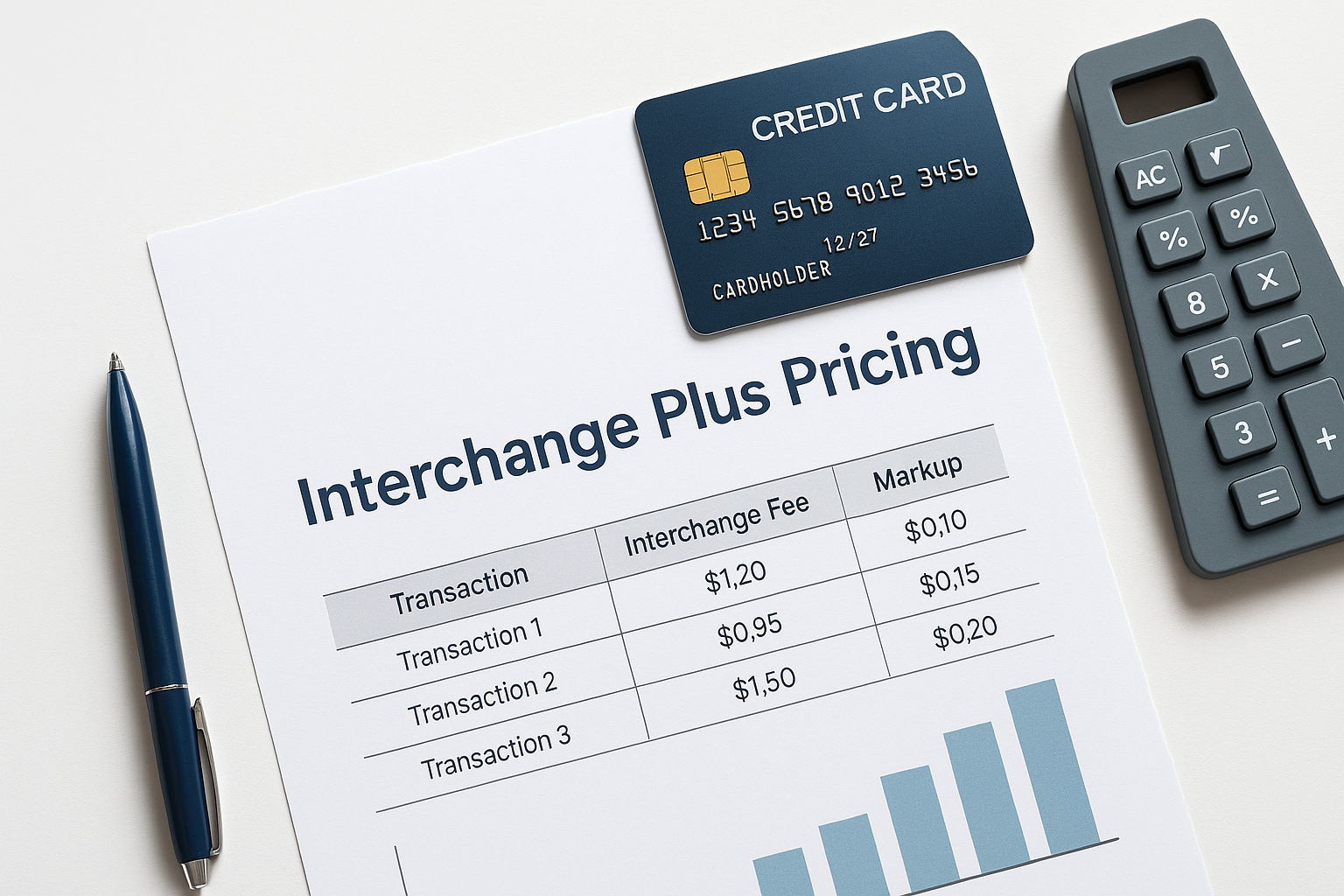
Interchange plus pricing is a payment processing model where you pay two main components for each transaction:
- Interchange fee — the base fee set by the card networks and paid to the card-issuing bank
- Processor markup — the fee charged by your payment processor
The card networks such as Visa and Mastercard determine interchange rates. These rates vary based on several factors, including card type, transaction method, industry, and whether the card is swiped, dipped, or entered manually.
Your processor then adds a fixed markup, which may include a small percentage, a per-transaction fee, or both. Because the processor’s markup is shown separately from the interchange cost, you can see exactly what portion of the fee goes to the card network and what portion goes to your provider.
How Interchange Plus Pricing Works
To understand interchange plus pricing, it helps to look at a simple example. Let’s say your business processes a $100 card payment. The interchange fee on that transaction might be 1.80% + $0.10, while your processor charges 0.25% + $0.10 as markup.
In that case, your total processing cost would look like this:
- Interchange: $1.80 + $0.10
- Processor markup: $0.25 + $0.10
- Total fee: $2.15 + $0.20, or $2.35
This structure is appealing because you can see the exact rate and fee components. If interchange rates change, your cost changes accordingly, but the processor’s markup stays the same unless your agreement changes.
That clarity is one of the biggest advantages of interchange plus pricing. Instead of paying a single blended rate that hides the underlying costs, you see the breakdown for every transaction.
Why Businesses Like Interchange Plus Pricing
Many merchants prefer interchange plus pricing because it offers transparency and fairness. Here are some of the biggest benefits:
1. Greater transparency
You can see precisely what you’re paying in interchange and what you’re paying in processor fees. This makes it much easier to review monthly statements and identify hidden costs.
2. Easier comparison shopping
Because the markup is separate from interchange, it’s simpler to compare processors. You can ask vendors what their markup is instead of trying to decode a blended rate that may include many assumptions.
3. Potentially lower costs for many merchants
For businesses with a healthy mix of card types and transaction methods, interchange plus pricing often leads to lower overall costs than flat-rate or tiered pricing. Since you pay the actual interchange rate plus a consistent markup, you’re not subsidizing other merchants’ expensive transactions.
4. More predictable profit margins for high-volume businesses
Businesses that process a lot of card payments often benefit from the consistency of a known markup. As sales grow, the processor’s fee structure remains easy to track.
Interchange Plus vs. Flat-Rate Pricing
Flat-rate pricing charges the same percentage for most transactions, regardless of the true interchange cost. A popular example is charging 2.9% + $0.30 per transaction. This model is easy to understand, but it can be more expensive for merchants whose actual interchange costs are lower than the flat rate.
With interchange plus pricing, you pay the true interchange rate plus a smaller markup. That means low-cost transactions often stay low-cost, while more expensive transactions cost more because the interchange rate is naturally higher.
Flat-rate pricing may be simpler for very small businesses or startups that want minimal complexity. Interchange plus pricing is often better for merchants that want transparency and a more accurate reflection of processing costs.
Interchange Plus vs. Tiered Pricing
Tiered pricing groups transactions into categories such as qualified, mid-qualified, and non-qualified. The problem is that the tiers often lack transparency, and many merchants don’t know which transactions fall into each bucket until they see their monthly statement.
Tiered pricing can make it difficult to tell whether you’re getting a good deal. One processor’s “qualified” tier may still cost more than another processor’s interchange plus offer.
By contrast, interchange plus pricing avoids the hidden assumptions built into tiered models. You can see the actual interchange cost and processor markup, which makes billing easier to understand and audit.
What Affects Interchange Rates?
Interchange rates are not one-size-fits-all. They depend on several factors that determine the risk and processing cost of each transaction. Common influences include:
- Card type: Rewards cards, business cards, and premium cards usually carry higher interchange fees
- Transaction method: Card-present transactions often cost less than keyed-in or online transactions
- Industry type: Some industries are considered higher risk and may see different rates
- Security level: Transactions that use chip technology, AVS, or tokenization may qualify for lower rates
- Transaction size: Larger or smaller ticket sizes can influence how fees are calculated
These variables matter because interchange plus pricing passes through the actual cost of each transaction. If your customers use a mix of debit cards, credit cards, and rewards cards, your effective rate will vary from month to month.
Common Fees to Watch For
Even with interchange plus pricing, not every fee will be part of the interchange and markup breakdown. Merchants should still review statements carefully for additional charges such as:
- Monthly account fees
- PCI compliance fees
- Gateway fees
- Batch fees
- Chargeback fees
- Statement fees
- Early termination fees
Some of these fees are standard, while others may be negotiable or unnecessary depending on your setup. The best providers are clear about which fees are required, which are optional, and which services they include in the markup.
Is Interchange Plus Pricing Right for Your Business?
Interchange plus pricing is a strong fit for many merchants, but it isn’t automatically the best choice for everyone. It tends to work well if you:
- Want full visibility into processing costs
- Process enough volume for small markup differences to matter
- Prefer an honest, itemized fee structure
- Want to compare processors more easily
It may be less attractive if you run a very small business and value simplicity above all else. In that case, a flat-rate model might be easier to manage, even if it costs a bit more. However, many small businesses still choose interchange plus because the transparency makes it easier to grow without surprises.
The key is to look at your average ticket size, monthly volume, and the kinds of cards your customers use. Those details will help you determine whether interchange plus pricing will save money or simply add complexity.
How to Evaluate a Processor Offering Interchange Plus Pricing
Not all interchange plus offers are created equal. When comparing providers, ask the following questions:
- What is your exact markup over interchange?
- Are there any monthly minimums?
- Which additional fees apply, and are they negotiable?
- Do you add PCI, gateway, or statement fees?
- Is there a contract term or cancellation fee?
- How often do you review and update rates?
It’s also a good idea to ask for a sample statement. A reputable provider should be able to show how a transaction is priced and explain each line item clearly. If a salesperson avoids specifics or promises “the lowest rates” without details, that’s a red flag.
Tips for Keeping Processing Costs Low
Even with interchange plus pricing, you can take steps to reduce your total processing expenses:
- Encourage chip or tap payments whenever possible
- Use address verification and other fraud-prevention tools
- Keep chargebacks low by maintaining clear billing and refund policies
- Review statements regularly for unused services or unexpected fees
- Negotiate your processor markup as your volume grows
Small operational improvements can lead to meaningful savings over time. In many businesses, lowering fraud and chargebacks can have just as much impact as negotiating a better rate.
Conclusion
Interchange plus pricing is one of the most transparent ways to pay for credit card processing. By separating the card network’s interchange fee from the processor’s markup, it gives merchants a clearer view of their true costs and makes it easier to compare providers. While it may take a little more effort to understand than flat-rate pricing, the clarity and potential savings often make it worth it. If you want a pricing model that rewards transparency and scales well as your business grows, interchange plus pricing is definitely worth a closer look.